| CSC 207 | Grinnell College | Fall, 2018 |
| Algorithms and Object-Oriented Design | ||
This lab provides practice with several basic algorithms related to heaps, as implemented with arrays.
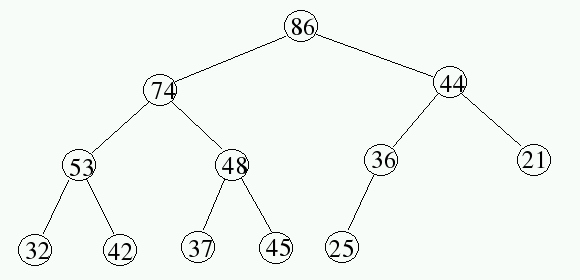
A max-heap is a binary tree with the property that the value at each node is larger (according to some ordering) than the values stored in either child. Similarly, a min-heap is a binary tree with the property that the value at each node is smaller (according to some ordering) than the values stored in either child.
Further, we restrict our attention to trees which are completely balanced. All nodes have 2 children, except at the bottom of the tree. The last row of the tree may not be full, but any items on the last level are moved left as much as possible. For example, the following tree illustrates the shape of a tree and the ordering of values within the tree for a max-heap.
To identify the nodes in a tree, the simplest approach is to number the nodes level-by-level from the root downward. Within a level, nodes are numbered left to right.
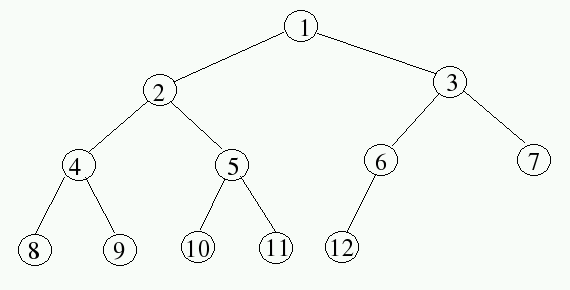
In examining the label nodes, a pattern emerges: for each node labeled i, the left child has label 2*i and the right node has label 2*i+1.
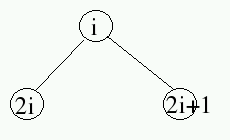
Note: Weiss's text uses this numbering scheme in writing code, with the top node numbered 1. If one considers an array element 0, Weiss suggests filling that position with -∞ for a min-heap or ∞ for a max-heap.
If we start labeling at 0 rather than 1, the labeling of nodes becomes:
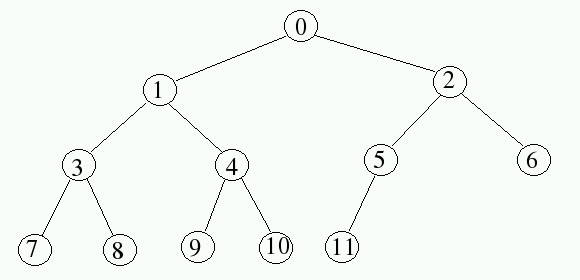
In the context of 0-based labeling, identify a pattern for moving from a node with label j to its left child and its right child. What labels would be found on the left and right nodes of a node with label j?
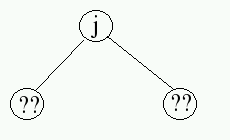
Since nodes in a heap fit a straight forward identification system, there is a natural mapping between the logical nodes in a heap and the indexed elements of an array.
In class we considered how to insert an item into a heap and maintain the structure. In each case, we first place the item at the end of a tree (as far left as possible in the last row). The item then is worked up from its position, until the data in the tree are appropriately ordered.
The following heap repeats the structure given at the beginning of this lab:
Using this structure as a start, insert the values 30, 25, 55, 81, and 95. Show the structure of the tree and the values in each node after each insertion.
In class, we also considered how to remove the top-priority item from a heap: remove the root as the item to be returned, move the last item from the end of the heap to the root, and work that item down in the heap until the data are properly ordered.
In class, we discussed starting with an array of data and working from the bottom toward the top to rearrange the data to yield a heap. For Steps 4 and 5, consider working with a min-heap.
In the following steps, consider a heap implemented with 0-based indexing.
Suppose an array of twelve elements, a[12], is initialized with a[i] = 20-i for each i. What rearrangements, if any, need to be done in order to make the corresponding tree structure into a heap? Show the data in the array once a heap is achieved.
Suppose the array of twelve elements, a[12], is initialized with a[i] = i for each i. What rearrangements, if any, need to be done in order to make the corresponding tree structure into a heap? Show the data in the array once a heap is achieved.
The following parts of this lab are lightly edited from a "Heap Sort" lab, written by Jerod Weinmen.
Steps 6—9 of this lab refer to a partially-written HeapSort class.
Import this class into a heapsort package within eclipse.
The following code is taken from Figure 21.14 in Weiss.
     /**
      * Internal method to percolate down in the heap.
      *
      * @param hole the index at which the percolate begins.
      */
    private void percolateDown( int hole )
    {
        int child;
        AnyType tmp = array[ hole ];

        for( ; hole * 2 <= currentSize; hole = child )
        {
            child = hole * 2;
            if( child != currentSize &&
                    compare( array[ child + 1 ], array[ child ] ) < 0 )
                child++;
            if( compare( array[ child ], tmp ) < 0 )
                array[ hole ] = array[ child ];
            else
                break;
        }
        array[ hole ] = tmp;
    }
Recall that Weiss' code uses a special value -∞ as a special value at array location zero. This impacts where the children are, as well as how the size of the heap relates to the index of the last node.
In the next exercises, you will be modifying this method to use a zero-based heap, rather than the one-based heap this method is written for.
Record your answers to the following questions on paper, so as to help you develop your solution.
tmp to array[ hole ] and
vice-versa?
hole * 2 <= currentSizehole = child?
child accomplish? What
child is this? (No singing Greensleeves, now.) Left or right?
child == currentSize?
child++? (That is, what is
the meaning, not "the integer child is
increased by one").
compare statement indicate the increment
is reasonable and appropriate?
array[ hole ] = array[ child ];Why shouldn't we be worried about overwriting the array entry at
hole?
compare statement indicate this is the
appropriate action?
break out of the loop otherwise?
Complete the HeapSort class:
HeapSort.java contains several methods. Most
notably, heapsort, the implementation of a standard
heapsort given in Weiss Figure 21.28. Review that now and be sure
you understand how it works.
percDown method to be sure you understand
how it is supposed to work.
percolateDown as a model, implement
this version of percolate down, taking note of the following two
important differences:
array[0].
Test your implementation using the main method
in HeapSort.java.
If the answers are not correct, I suggest you use a smaller heap (i.e., 2(3+1)-1=7 nodes), and add print statements that tell you where the hole is, what is being swapped for what, and what indices the swap is between. In addition, you may wish to carefully review your answers to the questions in Exercise 1, and make sure the logic (in addition to the arithmetic) still holds for your implementation in Exercise 2.
|
created 7 May 2012 by Henry M. Walker revised 7 May 2012 by Henry M. Walker expanded with code 11 January 2013 by Henry M. Walker steps 4 and 5 clarified 13 December 2014 minor editing 30 November 2018 by Henry M. Walker |


|
| For more information, please contact Henry M. Walker at walker@cs.grinnell.edu. |