Warning:
This course is under development.
Although the basic structure of this course is largely established,
nothing on this Web site should be considered official or even possibly
correct.
DO NOT MAKE PLANS BASED ON THE CONTENTS OF THIS SITE UNTIL JANUARY, 2020.
Merge Sort with Lists
The reading on the merge
sort discussed an approach for sorting an array by successively
merging small ordered arrays to get larger ordered arrays. The
basic approach followed these steps:
-
Start with ordered arrays of size 1 (note: any array of size 1
is ordered), and merge these arrays of size
1 to get ordered arrays of size 2.
-
Merge the arrays of size 2 to get arrays of size 4.
-
Merge the arrays of size 4 to get arrays of size 8.
-
Etc.
When using arrays, we could access each array element immediately;
we did not have to start at position 0 in the array and move element
by element to get the nth item. Further, we could
keep track of bounds of array segments in loops as part of the merge
process. Pragmatically, we worked from array segments of size 1 and
processed larger pieces as the algorithm progressed
Although we used iteration in the algorithm, recursion works just as
well (perhaps more simply). The basic approach for a recursive
algorithm starts with the large collection of data and recursive
relies on calls to sort smaller collections: This approach is outlined as
follows:
-
Start with a collection of n elements
-
if n is 0 or 1, the collection is sorted.
-
if n > 1,
-
Divide the collection of n elements into two pieces of half
the size (subcollection1 and subcollection2).
-
Recursively sort subcollection1 and subcollection2.
-
Merge subcollections1 and subcollection2 to obtain a full
collection of size n (the sorted version of the original
collection).
In code, this outline might proceed as follows when sorting items
within a list of ListNode elements:
  public ListNode mergeSortLists (ListNode ls) {
     /* handle base cases */
     if ((ls == null) || (ls.getNext () == null)
        {
          return ls;
        }
     /* divide ls into two pieces of approximately equal size*/
     ListNode sublist1 = ...
     ListNode sublist2 = ...

     /* sort both sublists*/
     sublist1 = mergeSortLists (sublist1);
     sublist2 = mergeSortLists (sublist2);

     /* merge the two lists to get the sorted result */
     return listMerge (sublist1, sublist2);
  }
With this code outlined, the work remaining involves
-
dividing a list into two pieces of approximately equal size.
-
merging two ordered lists into one.
Splitting a List into Two Pieces
This task can be handled in at least two ways, each of which
requires a little care, but neither of which requires extensive
coding.
-
Counting:
-
First count the items on the list (perhaps
getting a number
numb).
-
Starting at the beginning of the list again, count nodes until
reaching
numb/2. At this
point,
-
sublist2 can point to the next node.
-
The next field of node number
numb/2 can be
set to null.
sublist1 can now point to the first half of
the original list.
Overall with this approach, sublist1 references the
first half of the list, and sublist2 references the
second half of the list.
-
Alternating assignments:
-
In going through the list, assign successive nodes, first to
the end of
sublist1 and then to the end
of sublist2
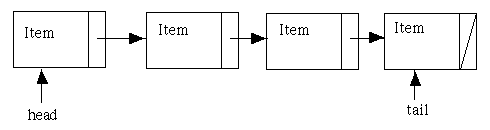
In following this approach, note that finding the end of a
sublist can be time consuming, if one starts at the beginning
each time. Thus, in this setting, we use sublist1
and sublist2 to keep track of the head of each
created list, and separate variables can keep track of the tail
of each list:
Merging Lists
The reading on the merge
sort presented the following outline for merging two sorted
collections:
-
As long as items exist in both array segments:
-
examine the first item in each array segment, copy the smaller to
the new array, and ignore the copied element in further processing.
-
Copy any remaining elements from the first array segment to the new
array.
-
Copy any remaining elements from the second array segment to the new
array.
Although work for this lab involves merging lists rather than arrays, the same outline
applies—moving list nodes rather than array elements.
Work for this Lab
-
Create a mergeSortLists method within a list class,
such as NameList,
including the basic code structure identified above.
-
Use either the counting or alternating assignments method to
split a list into two pieces of approximately equal size.
-
Write a method
ListNode mergeSortLists (ListNode sublist1, ListNode sublist2)
that follows the above outline to merge ordered two lists into one.
Note that completing the above three steps should yield a complete merge sort for lists!
-
Add some testing to your list class, so this merge sort
algorithm can be tested appropriately.

