Warning:
This course is under development.
Although the basic structure of this course is largely established,
nothing on this Web site should be considered official or even possibly
correct.
DO NOT MAKE PLANS BASED ON THE CONTENTS OF THIS SITE UNTIL JANUARY, 2020.
Laboratory Exercise on Queues with Arrays
Queues as ADTs
Today's reading on queues describes a queue as an ADT that can store data
and that has the following operations:
-
initializeQueue
Initializes an empty queue object.
isEmpty
Determine whether the queue is empty; return true if it is and
false if it is not.
isFull
Determine whether the queue is full; return true if it is and
false if it is not.
enqueue
Add a new element at the rear of a queue.
dequeue
Remove an element from the front of the queue and return it. (This
operation cannot be performed if the queue is empty.)
front
Return the element at the front of the queue (without removing it from the
queue). (Again, this operation cannot be performed if the queue is empty.)
A Potential Queue Interface in Java
Typical methods for a queue follow:
   /* a constructor for an empty queue
   */

  /* return whether the queue is empty
     pre:  queue is an initialized queue
     post: returns true if queue is empty;
           false otherwise
   */
  public boolean isEmpty ()

  /* return whether the queue is full
     pre:  queue is an initialized queue
     post: returns true if an additional item
              cannot be added to the queue;
           false otherwise
   */
  public boolean isFull ()

  /* insert given item into back of the queue
     pre:  the specified queue is initialized
     returns:  null if queue is full
               otherwise, reference to item added
   */
  E enqueue (E item)

  /* removes front item from queue referenced by parameter
     pre:  the specified queue is initialized
     returns:  null if queue is empty
               otherwise, reference to the item removed
   */
  E dequeue ()
Implementing Queues with Arrays
Be sure you have read the
reading on queues, particularly the reading on the
implementation of queues by arrays, before continuing.
In this part of the lab, we will focus on arrays of generic type
E. The relevant fields are:
  public class Queue <E> {
    protected first;
    protected last;
    protected count;
    E queueArray [] ;
    ...
A constructor would initialize the queueArray to an
array of a specified size. (Pragmatically, the size might be a
constructor parameter.)
Work Started in Class
Additional implementation notes may be found in today's reading on Queues.
-
Write two implementations of a queue of strings by implementing these
operations.
-
In one implementation, use the following interpretations for the
first and last fields (as discussed in the right column).
-
last designates the location of the most recent item inserted into
the queue. (lastA in the diagram.)
-
first designations the location where the next item will be
removed from the queue.
-
In the second implementation, use the following interpretations for the
first and last fields (as discussed in the right column).
-
last designates the location where the next item will be inserted
into the queue. (lastB in the diagram.)
-
first designations the location where the previous item was
removed from the queue.
-
Use the queue operations within a main procedure to provide
thorough testing of each operation.
Homework
-
Add to the queue ADT an additional procedure print
that displays each of the elements of the queue on a separate line
(without actually removing any of them from the queue).
-
An alternative approach for the dequeue procedure would add a
parameter item to the list of parameters and change the return type
to an int type. The idea is that the string would be
returned as a parameter char * item and the procedure would return
the length of the string item or -1 if the queue was empty.
The relevant procedure signature might be:
int dequeue (stringQueue * queue, char ** item)
and this procedure would be called within the context:
  char * frontItem;
  int returnValue;
  stringQueue myQueue;
  ...
  returnValue = dequeue (&myQueue, &frontItem)
-
The parameter item has type char **, and the
call to queue includes &frontItem. Explain why
** and & are needed here.
-
Write this alternative version of the dequeue operation.
Two alternative interpretations of last, and two for
first
Typically, the last records where new items will be added to a
queue. However, at least two interpretations are possible:
-
last might designate the location of the most recent item inserted
into the queue. (lastA in the diagram.)
-
last might designate the location where the next item will be
inserted. (lastB in the diagram.)
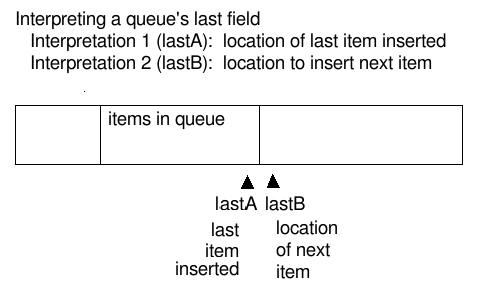
In the diagram, note lastB = lastA + 1
In an array implementation of a queue, either interpretation can work
without trouble, but the details are different:
-
When using lastA, one increments lastA first and then
inserts the new item.
-
When using lastB, one inserts the new itme and then inserts
lastB.
Also, assuming the very first item will be placed in array element 0, the
initializations of the index fields must be different.
-
lastA should be initialized to MaxQueue-1, so the initial
increment (modulo MaxQueue will set lastA to 0.
-
lastB should be initialized to 0, as that is the desired initial
location.
As noted, either approach can work without trouble, but mixing the two
interpretations will likely yield errors. Choosing an interpretation may
be called specifying an invariant of the queue code. Throughout all
queue operations, the interpretation of last (i.e., using
lastA or lastB) never varies. Likely the code will use
the simple field name last, but the programmer will need to have
decided which approach is being used.
A similar two choices are possible for first
-
first might represent the location of the next item to be
returned.
-
first might represent the location of the last item returned.
created 16 August 2011 by Dilan Ustek (questions by Henry Walker)
revised 16 August 2011 by Dilan Ustek
reformatted and edited 4 February 20134 by Henry M. Walker
readings added 19 September 2014 by Henry M. Walker
revised to updated format 14-16 April 2016 by Henry Walker
reorganized into two labs 1 February 2020 by Henry Walker
|


|