| CSC 161 | Grinnell College | Spring, 2012 |
| Imperative Problem Solving and Data Structures | ||
Stacks
Abstract
This reading introduces the concept of an Abstract Data Type (ADT) and describes a stack as a specific example.
Acknowledgement
Most of this reading is an edited version of Henry M. Walker, Introduction to Computing and Computer Science with Pascal, Little, Brown, and Company, 1986, Sections 17.1-17.2, 17.4, with programming examples translated from Pascal to C. This material is used with permission from the copyright holder.
Abstract Data Types
When we want to work with data on a general level, we often need to describe two basic characteristics: the data we will be storing, and the operations we will want to perform on these data. In computer science, these two characteristics combine to give the concept of an abstract data type or ADT which allows us to work with data on a conceptual level without worrying about various programming details.
The stack discussed in this lab provides one example of an abstract data type. The queue, discussed in a forthcoming lab, provides a second example.
Stacks
A stack mimics the information that we might keep in a pile on our desk. For example, on our desk, we may keep separate piles for
- bills that need paying;
- magazines that we plan to read; and
- notes we have taken.
These piles have several properties. First, each pile contains the same type of information (e.g., bills, magazines, or notes). In addition, for each pile, we can do several tasks.
- We can add to the pile by putting information on the top.
- We can take the top item off of our pile.
- We can read the item on the top.
- We can tell if a pile is empty. (There may be nothing at the spot where the pile should be.)
These operations allow us to do all of our normal processing of data at our desk. For example, when we receive bills in the mail, we add them to our pile of bills until payday comes. Then, we take our bills, one at a time, off the top of our pile and pay them until our money runs out.
When discussing these operations, it is customary to call the addition of an item to the top of the pile a Push operation and the deletion of an item from the top a Pop operation.
More formally, a stack is defined as an abstract data type that can store data and that has the following operations:
-
Empty
Empty returns true or false, depending upon whether the stack contains any items or not. -
Full (optional)
Full returns true or false, depending upon whether the stack contains as much data as it can hold. -
Push
If the stack is not full, Push adds the specified item to the top of the stack.
If the stack is full, nothing is added, and an error is reported. -
Pop
If the stack is not empty, Pop removes the top item from the stack, and this item is returned.
If the stack is empty, nothing is returned, and an error is reported. -
Top
If the stack is not empty, the top item is returned, but the contents of the stack are not changed.
If the stack is empty, nothing is returned, and an error is reported.
This specification says nothing about how we will program the various stack operations; rather, it tells us how stacks can be used. We can also infer some limitations on how we can use the data. For example, stack operations allow us to work with only the top item on the stack. We cannot look at other pieces of data lower down in the stack without first using Pop operations to clear away items above the desired one.
A Push operation always puts the new item on top of the stack, and this is the first item returned by a Pop operation. Thus, the last piece of data added to the stack will be the first item removed. For these functions (along with initialize), you have to pass a pointer to the top of the stack and cannot pass in the actual element, because you need the ability to modify the stack itself, not just a copy of the element on top. For other functions which deal with the stack, you can generally pass in either a pointer to the top of the stack, or the actual element itself.
Implementation of Stacks by Arrays
Stacks in C
One common implementation of a stack involves the use of an array.
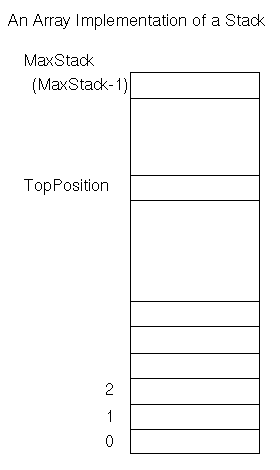
More precisely, we store each piece of data as an element of an array. We place the first data item at one end of the array. Then, for a Push operation, we add a data item to the next array element. For a Pop operation, we return the item at the top of our data, and we record that the top has moved down. This processing requires several parts, including an array (StackArray) of data to store our data items, a variable (topPosition) to keep track of our top element, and a constant (MaxStack) to keep track of the size of our array. Conceptually, this setup fits together as shown in the figure. Note that a stack implementation may have the topPosition as either the top element in the stack, or a pointer to the top empty element. Both implementations of stacks are valid.
With this figure, we trace what happens in our stack operations. We start with topPosition equal to -1, since we have no data in the array. Then, we perform a Push, we increment topPosition by one, and we store our new item in this new topPosition. Similarly, for a Pop operation, we return the item at the topPosition, and we move the topPosition down by one. Finally, for Full or Empty functions, we compare the topPosition with MaxStack-1 or -1, respectively.
Additional details arise because we must check if the stack is full or empty before actually performing a Push or Pop operation, respectively.
Finally, we note that sometimes it is convenient to package the elements together in a struct construction, perhaps with a typedef. For example, the following declarations might be used when the stack is to store strings.
   #define MaxStack 50;  /* MaxStack stands for the size
                            of all stack arrays */

   typedef struct {
      int topPosition;
      char * stackArray [MaxStack];
   } stringStack;      /* type for a stack of strings */
Implementation of Stacks by Pointers
The previous section on stacks described the use of arrays to implement this abstract data type. That section utilized the following declarations and function prototypes:
   #define MaxStack  50  /* MaxStack stands for the size of all stack arrays */

   typedef struct {
      int topPosition;
      char * stackArray [MaxStack];
   } stringStack;

  int empty (stringStack stack)
  int full (stringStack stack)
  void initializeStack (stringStack * stack)
  char * pop (stringStack *stack)
  int push (stringStack *stack, char * item)
  char * top (stringStack stack)
In this section, we implement the same operations using lists and pointers. Further, since applications should consider only the conceptual operations of an abstract data type, not the implementation details, we will be careful that the new code we develop still uses exactly the same procedure and function headers as defined earlier for arrays.
When describing this new approach to a stack, we focus on the specification of the top of the stack, and we consider how to locate subsequent times in the stack after we perform a Pop operation. The following figure shows how such a structure could be organized.
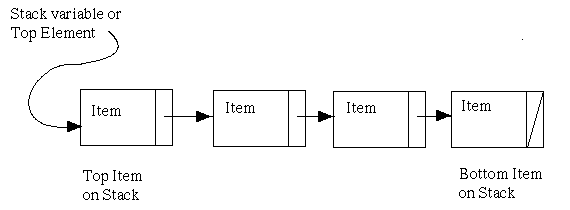
In this picture, we store a stack Item in a record with a pointer to the next lower Item on the stack. Also, we use a pointer variable, which specifies the top record.
Now suppose that we decide to store string data within a node. There are at least two choices to store the string data:
-
The node could store a pointer to a string, in which case the appropriate declarations for a stack with string data are:
typedef stackNode * stringStack; struct node { char * stackArray; struct stackNode * next; } stackNode; stringStack stack; -
The node could contain a copy of the data, leading to these declarations for string data.
   typedef stackNode * stringStack;
   struct node {
      char stackArray [MaxStringLength];
      struct stackNode * next;
   } stackNode;

   stringStack stack;
In this case, we would copy an original string into the node for a push operation. A top or pop operation would allocate new space (with malloc) for a new string to be returned; then after the new space is allocated, the string stored at the top of the stack would be copied into this new space.
With these declarations, we initialize stack to NULL at the beginning of the program, and the Boolean expression
Stack == Nilallows us to test for an empty stack. Then the Push, Pop, and Top operations involve inserting, deleting, and reading items at the top of this list structure, respectively. With the use of dynamic storage allocation, there is no need to declare a list size initially, and the Full operation is not needed. However, for compatibility with the earlier array implementation of stacks, this function is still included and will always return False. The outlines of these operations are quite similar to the work in the earlier ones. Also, in the Pop operation, we free the list item once we have returned the appropriate information. The coding details for these operations are shown below.
Once these functions and procedures are defined, we can use them just as we did before. In a program, we must include the appropriate stack declaration (shown earlier in this section); we must write out these procedures; and we must call the Initialization procedure. However, once these details are completed, the compatibility of the procedure and function headers allows us to use Empty, Push, Pop, and Top without change. Thus, while the implementation of stacks has changed dramatically, the use of stacks in applications is identical.
This document is available on the World Wide Web as
http://www.walker.cs.grinnell.edu/courses/161.sp12/modules/module-pointers-stackes-queues/stacks-reading.shtml
|
created 28 April 1997 by Henry Walker revised 4 April 2010 by Henry Walker revised 17 August 2011 by April O'Neill revised 5 December 2011 by Erik Opavsky |


|
| For more information, please contact Henry M. Walker at walker@cs.grinnell.edu. |