Work Started in Class
-
Write the details for a countList () method which counts the number of items in the list.
To perform this task, you will want to move along the list item-by-item, counting the items as you go.
-
Write the details for a method printLast () which should print the data for the last item on the list. (If the list is null, the procedure should print a message to that effect instead.)
To perform this task, proceed iteratively, moving along the list item-by-item until coming to the end, where the next field is NULL .
-
Write a method countOccurances (String str) that counts the number of times that the string
strappears on the list.Test your program to see if it works for different cases such as a null list.
-
Add a method
getIndexthat fines the first index of the stringstrin a list. As parameter, it should take a string to look for, and it should produceindex, an integer as a result, wherestris located at theindexth position on the list, counting the first node as position 1.For example, consider the following list:

-
getIndex ("study CS")would return 1 -
getIndex ("Read email")would return 3 -
getIndex ("not here")would return 0, as a signal that the string is not present on the list.
-
-
Write the details for putFirst ( ) method which reads the name of an item on the list and moves that item to the front of the list.
To perform this task, you first have to read in the name of the item desired. Then you need to search the list item-by-item to find the desired item. Next you need to remove that given item from its current place in the list (if it is not already first). Finally you need to insert that given item at the beginning of the list.
Since manipulation of lists is most efficient if only references are manipulated, your program should neither create new nodes nor dispose of existing ones.
In effect, you will be reassigning several references. Consider a list where the item
"sought"appears somewhere in the middle of the list, as shown below.
After
putFirstruns, the various pointers will be reassigned as follows.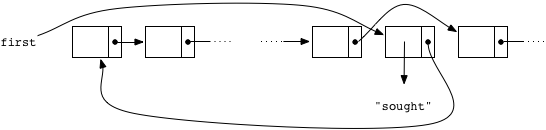
Your search loop must account for the need to manipulate the
nextfield of the node preceding the entry containing"sought". (Alas, there is nopreviousfield in our list node structure.)Finally, your program should respond appropriately in all cases. In particular, putFirst should print appropriate messages if either list is null or the item designated is not found on the list.

